
Why Is WhatsApp Business Asking You to Pay for Broadcasts? (2026 Explained)
WhatsApp Business now asks for payment after a free monthly broadcast allowance. What message credits are, why you hit 'you have reached the broadcast limit', what it costs, and the cheaper way to reach more customers.
هذا المقال متوفر باللغة الإنجليزية.

نُشر في
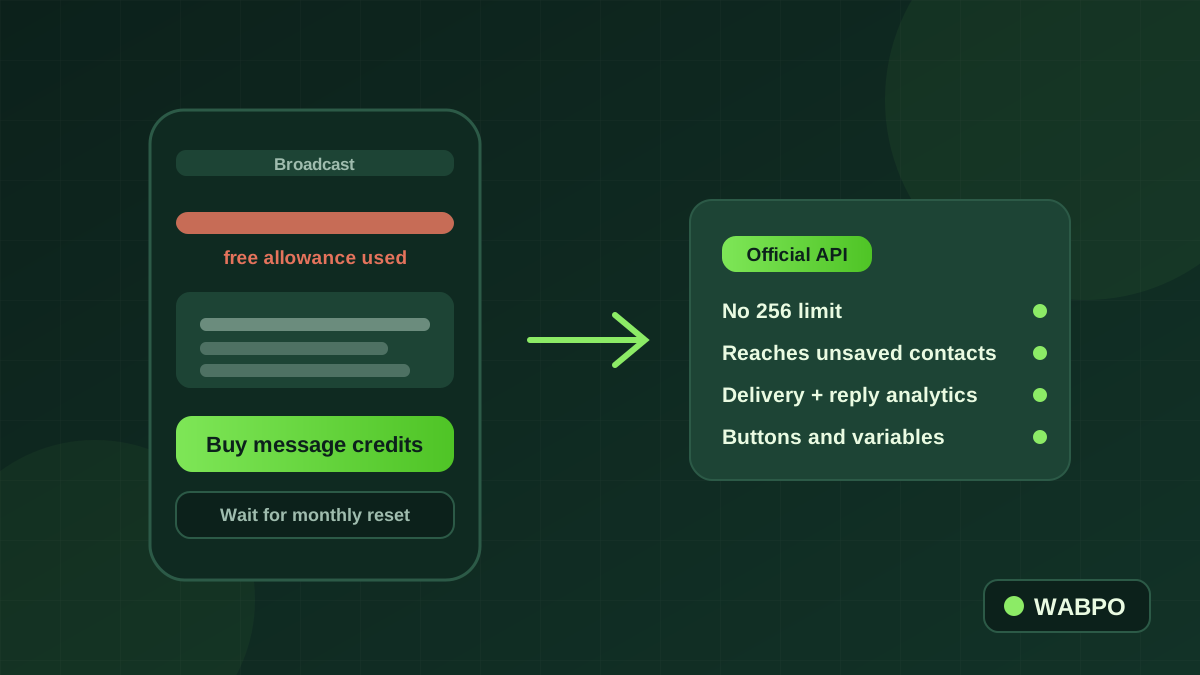
The short version: broadcasts in the WhatsApp Business app are no longer unlimited. Meta now gives each business a free monthly broadcast allowance, and once you've used it, sending more means buying message credits (also called message packs) inside the app. That's why the payment screen appeared — and why you may have seen "you have reached the broadcast limit". Your number isn't restricted, your account isn't in trouble, and normal one-to-one replies are unaffected.
WhatsApp documents this in its own Help Center: About pricing for business broadcasts, About message packs for business broadcasts, and How to pay for ads and business broadcasts.
What actually changed
For years, a broadcast list in the WhatsApp Business app was free and capped only by the 256-contact list size. Meta has been tightening that: broadcasts are now metered by message credits, with a monthly free allowance that resets each month. When the allowance runs out, the app offers a message pack instead of sending.
Why WhatsApp started charging for broadcasts
Two reasons, and both are worth understanding because they tell you where this is heading:
- Inbox protection. Unlimited free broadcasting is a spam engine. A price — however small — makes senders ask "is this message worth it?", which is exactly the question that keeps WhatsApp worth opening.
- Business messaging is now a product line. Meta is monetising business messaging across the board: paid broadcasts in the app, and on the API side, service replies becoming billable from October 1, 2026. The free era is closing at every level, not just yours.
Is WhatsApp broadcast free or paid? The honest table
| WhatsApp Business app | WhatsApp Business API | |
|---|---|---|
| Broadcast cost | Free monthly allowance, then paid message credits | Per-message fee set by Meta for your country |
| Who receives it | Only people who saved your number | Any opted-in contact — no need to be saved |
| Audience size | 256 per list, sent list by list | No list cap; daily tiers from 250 to 100,000+ |
| Personalisation | Name only, manual | Variables: name, order, balance, appointment |
| Analytics | None | Per-recipient delivered, read, replied, failed |
| Buttons & lists | No | Yes — tappable replies and menus |
| Team access | One phone | Shared inbox with assignment and history |
That "only people who saved your number" row is the one that costs businesses the most money, and almost nobody notices it. In the app, a broadcast to 256 contacts might reach 60 people, because the rest never saved you — and you have no way of knowing which. You pay (in credits or in time) for 256 and reach a fraction.
What to do when you hit the limit
Option 1 — buy message credits
Right for small, occasional senders: a salon announcing holiday hours, a shop with one promotion a month. It's the path of least resistance — tap through the in-app purchase and keep going. It stops making sense when you're buying credits every month, because you're paying for reach while still missing everyone who didn't save your number, and still getting zero analytics.
Option 2 — send fewer, better broadcasts
Unglamorous and genuinely effective. Most businesses broadcast to everyone every time. Segment first: the customers who bought this category, the ones who lapsed 60 days ago, the ones who asked about a restock. One relevant message to 200 people beats four generic messages to 800 — cheaper on credits, better for replies, and far better for your block rate.
Option 3 — move to the official API
Right when broadcasting is a real channel rather than an occasional announcement. On the official WhatsApp Business API, you pay Meta's per-message rate for your country — see the Meta rates page — and in exchange the 256 cap disappears, recipients don't need to have saved you, messages carry variables and buttons, and every send reports delivery, reads and replies. Run your own numbers first with our free WhatsApp API cost calculator.
"You have reached the broadcast limit" — is my account in trouble?
No. It's a billing message, not a penalty. It means this month's free broadcast allowance is used up. Your number is fine, your quality rating is untouched, and ordinary chats keep working normally. Your options are to buy a message pack, wait for the monthly reset, or move broadcasting to the API. If you're seeing it every month, that's not a problem to solve with credits — it's a signal that broadcasting has become a real channel for you and deserves proper infrastructure.
How to spend less on broadcasts, whichever route you take
- Clean the list. Paying to message wrong numbers and long-dead leads is the most common waste there is.
- Segment before you send. Relevance is the cheapest optimisation available — fewer messages, more replies.
- Say one thing per broadcast. Messages with a single clear action outperform announcements carrying three.
- Give a reason to reply, not just to read. A reply opens a 24-hour service window where conversation can continue — and conversations, not blasts, are what actually convert.
- Respect opt-outs immediately. Blocks and reports damage delivery for every future message, which is far more expensive than any credit pack.
- Measure per message. Without delivery and reply data you're optimising blind; that visibility is a large part of what the API is really buying you.
For the complete picture on limits, rules and costs across both routes, see our WhatsApp broadcast limit, rules and cost guide — and if you're worried about your number's health while scaling, how to send bulk messages without getting blocked.
أسئلة شائعة
Why is WhatsApp Business asking me to pay for broadcast messages?
Because broadcasts in the WhatsApp Business app now have a free monthly allowance, and you've used yours. Sending more that month requires buying message credits (message packs) in the app. It's a billing prompt, not a penalty — your number and account are unaffected, and normal one-to-one chats still work.
Is WhatsApp broadcast free or paid in 2026?
Both, depending on volume and route. The WhatsApp Business app includes a free monthly broadcast allowance and charges message credits beyond it. The WhatsApp Business API charges Meta's per-message rate for your country on every broadcast, but removes the 256-contact limit, reaches contacts who haven't saved your number, and reports delivery and replies.
What does 'you have reached the broadcast limit' mean?
It means this month's free broadcast allowance in the WhatsApp Business app is used up. You can buy a message pack, wait for the monthly reset, or move broadcasting to the official API. Your account is not restricted and your quality rating is not affected.
What are WhatsApp message credits?
Message credits (sold as message packs) are the in-app currency for sending business broadcasts beyond your free monthly allowance in the WhatsApp Business app. WhatsApp documents them in its Help Center under 'About message packs for business broadcasts'.
How many free broadcast messages do I get per month?
It varies by country and account, and Meta has not published a single global figure — reported allowances differ widely, and new accounts may receive a larger introductory allowance. The reliable way to check is in the app itself: start a broadcast and read the allowance shown before you send.
Does the broadcast charge apply to the WhatsApp Business API too?
The message-credit system applies to the WhatsApp Business app. On the API, broadcasts have always been billed per message at Meta's country rates. Separately, from October 1, 2026 Meta also charges for service messages on the API after 1,000 free per phone number each month.
Is it cheaper to use the WhatsApp Business API for broadcasts?
Not always. For a couple of small broadcasts a month to saved contacts, in-app credits can be cheaper. The API wins when reach, personalisation, analytics and team access matter — no 256 cap, recipients don't need to have saved your number, and every message reports delivery and replies. Compare with your own volumes using a cost calculator before switching.
بقلم
Saifullah AlamFounder — Spadasoft, WABPO & WAWCD
Saifullah Alam is the founder of Spadasoft, WABPO and WAWCD. He builds WhatsApp Business API products that companies use for campaigns, chatbots and customer support — and writes practical, no-hype guides about WhatsApp marketing based on what actually ships.
تابع القراءة
WhatsApp Broadcast Limit, Rules and Cost: What's Free and What's Not
256 contacts per list, saved-contact rules, and Meta fees — here are the real WhatsApp broadcast limits, what's free, what's paid, and copy-paste message examples.
WhatsApp Service Message Pricing: What Changes on October 1, 2026 — and What It Really Costs Your Business
The famous free 24-hour window is ending. From October 1, 2026, Meta charges for every service message after 1,000 free per number each month — and utility templates inside the window are billed too. Here is exactly what changes, what it costs, and how to shrink the bill before it arrives.
How to Send Bulk WhatsApp Messages Without Getting Blocked
Bulk senders get WhatsApp numbers banned every day. The official WhatsApp Business API is the one way to send at scale safely — here is exactly how it works.