
WhatsApp Service Message Pricing: What Changes on October 1, 2026 — and What It Really Costs Your Business
From October 1, 2026 WhatsApp charges for service messages — free-form replies in the 24-hour window — after 1,000 free per number monthly. New rates, worked cost examples, and 7 ways to cut the bill.
هذا المقال متوفر باللغة الإنجليزية.

نُشر في
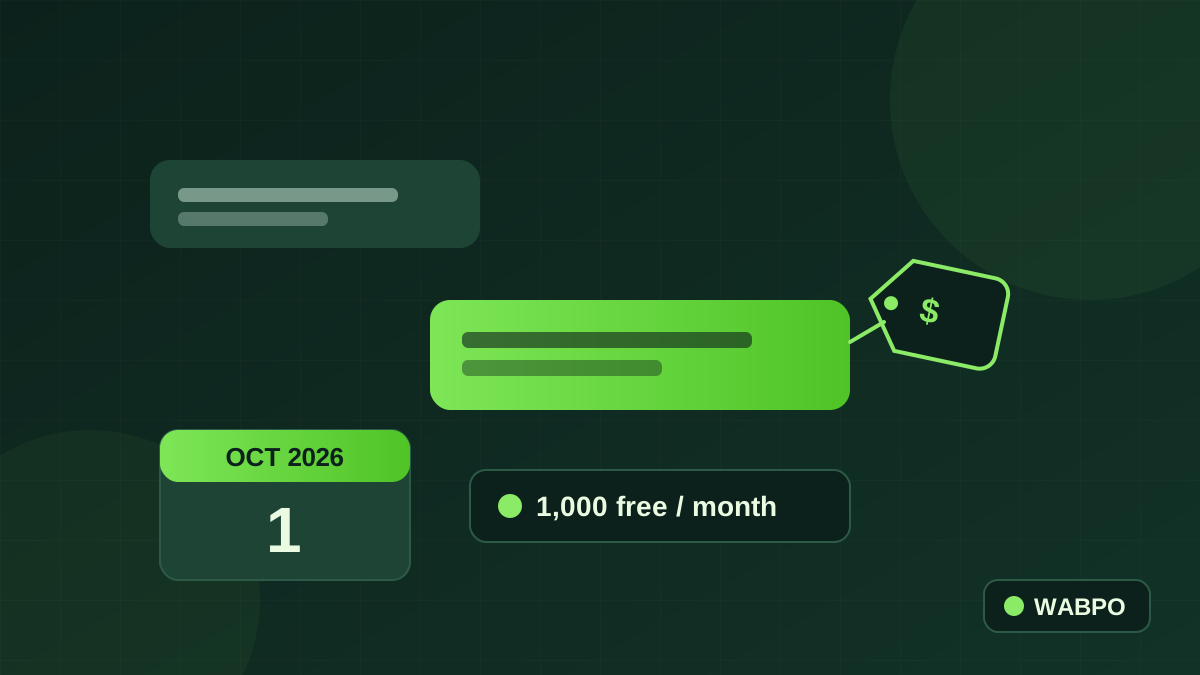
For years, the deal on the WhatsApp Business API was simple: templates cost money, replies are free. Once a customer messaged you, everything you sent back inside the 24-hour customer service window — human answers, chatbot replies, AI responses — cost nothing. That deal ends on October 1, 2026. Meta will charge for service messages (those free-form replies) on a per-delivered-message basis, at the same rate as utility and authentication messages in your market, after a free allowance of 1,000 service messages per business phone number per month. Utility templates sent *inside* an open window — free since July 2025 — will be billed too.
What exactly changes on October 1, 2026?
Four things change at once. Here is the before and after for every message type on the WhatsApp Business Platform:
| Message type | Until September 30, 2026 | From October 1, 2026 |
|---|---|---|
| Service messages (free-form replies in the 24-hour window) | Free, unlimited | First 1,000 per number/month free, then billed per delivered message at your market's utility/authentication rate |
| Utility templates inside an open 24-hour window | Free (since July 1, 2025) | Billed at the utility rate |
| Utility templates outside the window | Billed per message | Billed per message (unchanged) |
| Marketing templates | Billed per message | Billed per message — with rate increases in several markets |
| Authentication templates | Billed per message | Billed per message; authentication-international expands to more markets |
| Meta Business Agent messages (Meta's own AI) | Billing started August 1, 2026 | $2.00 USD per 1M tokens (~4–5¢ per message), no free window |
The service-message change is the one that rewrites budgets, because it puts a price on the part of WhatsApp most businesses treated as free forever: answering customers.
What is a service message on WhatsApp?
A service message is any non-template message you send inside the 24-hour customer service window — the window that opens (and resets) every time a customer messages you. It covers the everyday substance of WhatsApp support: a human agent typing an answer, a chatbot walking someone through a menu, a third-party AI reply, a photo of the product, a voice note, a document. If it isn't an approved template and it isn't sent by Meta's own Business Agent, it's a service message — and from October 1, 2026 it has a price.
Two things it does *not* cover: the consumer WhatsApp app and the free WhatsApp Business app are unaffected — this is API-platform pricing only. And inbound messages cost nothing; customers never pay, and you are not charged for what customers send you.
How the 1,000 free service messages work
- Per business phone number, per month. Each number connected to the platform gets its own 1,000-message allowance.
- It resets monthly and does not roll over. Unused allowance in September doesn't carry into October.
- No volume tiers. Meta explicitly offers no volume discounts on service messages — message 1,001 and message 1,000,001 cost the same rate.
- Delivered messages count. Billing follows delivery, consistent with how template messages are already charged.
For a small business answering a handful of chats a day, 1,000 free messages may genuinely cover the month. For a support team, it's a rounding error: one busy agent can send 1,000 replies in a week.
What will it cost? Two worked examples
Meta prices service messages at your market's utility/authentication rate, which varies by country — check the official rate cards and our Meta rates page for your number. The math below uses illustrative example rates ($0.005 and $0.01 per message) so you can see the mechanics; swap in your real rate.
Example 1: a three-agent support team
| Monthly volume | At $0.005/msg (example) | At $0.01/msg (example) | |
|---|---|---|---|
| Conversations handled | 2,500 | — | — |
| Outbound replies (avg 6 per conversation) | 15,000 | — | — |
| Minus free allowance | −1,000 | — | — |
| Billable service messages | 14,000 | $70/month | $140/month |
Example 2: the chatty chatbot
This is where costs quietly multiply. A bot that sends twelve short messages per conversation — greeting, menu, "please choose an option", confirmation, another menu — now costs three times as much as a bot that resolves the same question in four richer messages. Same outcome, same customer, 3× the bill. At 5,000 bot conversations a month, that's the difference between 20,000 and 60,000 service messages — at an example $0.005 rate, $95 vs $295 per month after the free allowance.
Utility templates inside the 24-hour window are billed too
Since July 1, 2025, a utility template (order confirmation, delivery update, payment reminder) sent while a customer-service window was open rode along free. From October 1, 2026 it carries the utility rate whether the window is open or not. If your order-update flow deliberately waited for an open window to send updates free, that optimization stops working — the sequencing no longer changes the price.
Market changes: nine countries go standalone, marketing rates move
- New standalone markets from October 1, 2026: Bangladesh, Iraq, Kazakhstan, Kuwait, Morocco, Nepal, Oman, Sri Lanka and Ukraine leave their regional "Rest of…" groupings and get their own rates and volume tiers.
- Lower utility and authentication rates are listed for Bangladesh, Iraq, Nepal and Sri Lanka; higher ones for Kazakhstan, Kuwait, Morocco, Oman and Ukraine (per Meta's pricing docs).
- Marketing rate increases were announced for several markets, including Saudi Arabia, the UAE, Kuwait, Morocco and Mexico, plus the Rest of Asia Pacific and Rest of Middle East groupings.
- Authentication-international eligibility expands to more markets, with Meta giving notice before charges begin.
If you message customers across borders, re-check every destination country's rate — a flow that was cheap into a "Rest of" grouping may now hit a standalone rate, in either direction.
Meta Business Agent: the token-priced alternative
Alongside these changes, Meta launched its own in-platform AI — the Meta Business Agent — with a different meter entirely: $2.00 USD per 1M tokens, roughly 4–5 US cents per message, billed from August 1, 2026, with no free window and no free allowance. Notably, replies from *third-party* AI (like the AI in your automation platform) bill as ordinary service messages — which in most markets costs a fraction of 4–5 cents. Running your own AI stack through service messages will usually be the cheaper route; the right comparison for your business is your market's utility rate vs ~$0.045 per Business Agent message.
Who feels this most
- Support-heavy teams — every reply after 1,000/month is now a line item; long back-and-forth threads are the new cost center.
- Multi-message chatbots — flows built in the free era love sending bursts of small messages; each burst is now billed per message.
- COD and order-confirmation flows — high-volume, message-dense conversations (confirm, address, time slot, reminder) accumulate fast.
- Businesses relying on in-window utility sends — the free ride on order updates inside open windows ends.
- Cross-border senders into the nine new standalone markets — rates change in both directions; assumptions from the regional groupings no longer hold.
Seven ways to cut your WhatsApp bill before October
The short version is below; the deep version — with before/after flow redesigns, the messages-per-conversation benchmark table, and how our engineers help — is in the flow-by-flow cost-cutting playbook. And to put numbers on your own situation first, the free WhatsApp API cost calculator estimates your post-October bill and simulates the savings.
- Count your current volume now. Pull last month's outbound replies per number. If you're under ~1,000/month per number, relax — this change may cost you nothing. Everyone else: multiply the overage by your market's utility rate for an instant budget forecast.
- Collapse message bursts into one rich message. One message with buttons and lists replaces three plain texts and a clarifying question — and cuts the same conversation's cost by half or more.
- Redesign chatbot flows for fewer touches. Every workflow step that sends a separate message is now a billable event. Merge greeting + menu, confirm in one message, and let AI answer complete questions in one reply instead of five fragments.
- Resolve in the first reply. The cheapest conversation is the short one — quick replies, saved answers and a shared team inbox that routes the question to someone who can actually answer it reduce round-trips.
- Rethink in-window utility sequencing. If flows deliberately delayed order updates to ride free inside open windows, simplify them — the discount is gone, so send at the time that serves the customer.
- Watch per-number allowances. The 1,000 free messages are per business phone number. Structure support lines so allowances aren't wasted on one number while another pays overage from day one.
- Track messages-per-conversation weekly. Make it a KPI. Teams that measure it drop it; teams that don't will discover it on Meta's invoice.
أسئلة شائعة
Is the WhatsApp 24-hour window still free?
Until September 30, 2026, yes — free-form replies inside the 24-hour customer service window cost nothing. From October 1, 2026, Meta charges per delivered service message after a free allowance of 1,000 messages per business phone number per month.
How much will WhatsApp service messages cost?
Service messages are priced the same as utility and authentication messages in your market — rates vary by country and are published in Meta's official rate cards. There are no volume discounts, and the first 1,000 per number each month are free.
Does the 1,000 free message allowance roll over?
No. The allowance is per business phone number, per month; it resets monthly and unused messages do not carry over.
Does the October 2026 pricing change affect the free WhatsApp Business app?
No. The change applies to the WhatsApp Business Platform (the API) only. The consumer WhatsApp app and the free WhatsApp Business app are not affected.
Are chatbot and AI replies charged as service messages?
Yes. Free-form replies from third-party chatbots and AI count as service messages, exactly like human replies. Meta's own Business Agent is the exception — it bills per token ($2.00 per 1M tokens, roughly 4–5 cents per message) with no free allowance.
Can a platform like WABPO help me avoid the new Meta fees?
No platform can — Meta bills service messages directly to your WhatsApp Business Account regardless of which tool you use. What a platform can do is avoid adding its own markup, show per-conversation message counts, and resolve conversations in fewer messages so the billable volume drops. That's WABPO's approach.
بقلم
Saifullah AlamFounder — Spadasoft, WABPO & WAWCD
Saifullah Alam is the founder of Spadasoft, WABPO and WAWCD. He builds WhatsApp Business API products that companies use for campaigns, chatbots and customer support — and writes practical, no-hype guides about WhatsApp marketing based on what actually ships.
تابع القراءة
WhatsApp Broadcast Limit, Rules and Cost: What's Free and What's Not
256 contacts per list, saved-contact rules, and Meta fees — here are the real WhatsApp broadcast limits, what's free, what's paid, and copy-paste message examples.
WhatsApp's Built-In AI and Paid Broadcasts vs WABPO: What Meta's New Features Actually Cover
Meta building AI replies and paid broadcasts into WhatsApp is good news — and it doesn't replace automation platforms. A feature answers a message; a platform runs the process.
WhatsApp Business API: A Beginner's Guide in Plain English
API sounds technical, but the idea is simple: it's WhatsApp built for businesses that outgrew the app. Here's everything a beginner needs to know.